
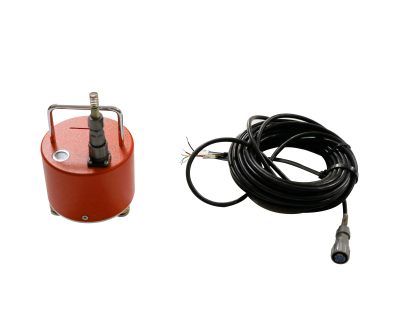
Selecting a three-component (3C) geophone requires an understanding of both the survey objectives and the sensor’s technical specifications. Natural frequency, sensitivity, coil resistance, mechanical dimensions and operating temperature all influence how a geophone performs in different field conditions.
For applications such as Horizontal-to-Vertical Spectral Ratio (HVSR) analysis, Multichannel Analysis of Surface Waves (MASW) and vibration monitoring, these parameters should be reviewed alongside the recording system and the planned deployment method.
Natural Frequency and Sensor Sensitivity
Natural frequency is an important consideration when selecting a geophone for seismic measurements. Sensors with different natural frequencies have different response characteristics, particularly at lower frequencies.
For example, the 4.5Hz three-component geophone uses a sensor with a coil resistance of 375Ω and an open-circuit sensitivity of 28.8 V/m/s. By comparison, the 2Hz triaxial geophone has a coil resistance of 5,800Ω and a sensitivity of 200 V/m/s.
A lower natural frequency can be useful for measurements involving low-frequency ground motion, including certain HVSR and microseismic applications. The appropriate choice, however, depends on the required frequency response and the characteristics of the recording equipment.
The sensors also differ in moving mass. The 4.5Hz element has a moving mass of 11.3g, compared with 60g for the 2Hz model.
When specifying either sensor, the input characteristics of the data acquisition system should be checked to ensure electrical compatibility. Coil resistance, sensitivity and damping characteristics need to be considered together rather than assessed individually.
Spurious Frequency and Harmonic Distortion
Spurious frequency is another parameter relevant to geophone selection, particularly where higher-frequency measurements are required.
The published specification for the 4.5Hz 3C geophone lists a typical spurious frequency of at least 160Hz. Both the 4.5Hz and 2Hz sensor specifications indicate harmonic distortion of no more than 0.2%.
For MASW and other surface-wave applications, the sensor’s frequency response and phase characteristics should be considered in relation to the expected measurement range.
Spurious frequency and harmonic distortion provide useful information, but they do not independently define the usable frequency range of a complete survey system. Recording equipment, sensor coupling and site conditions also influence the quality of the acquired data.
Mechanical Specifications and Field Conditions
Geophone dimensions, weight and housing design affect installation and handling during field surveys.
The 4.5Hz sensor measures 25.4mm in diameter and 36mm in height, with an element weight of approximately 86g. It can be incorporated into three-component housings suitable for surface-wave surveys, HVSR measurements and vibration monitoring.
The 2Hz triaxial sensor is larger, measuring 41.2mm in diameter and 47.5mm in height. The sensor weighs approximately 260g, while the complete three-dimensional geophone assembly weighs around 2.2kg.
These differences may influence the choice of housing, mounting arrangement and deployment method, especially where multiple instruments need to be installed across a survey area.
Operating temperature is also relevant. The 4.5Hz sensor is specified for temperatures from -40°C to +55°C, while the 2Hz triaxial model is rated from -30°C to +55°C.
For surveys conducted in cold regions or locations with significant temperature variation, the operating limits of both the sensor and the complete acquisition system should be reviewed before deployment.
Equipment Compatibility and Technical Documentation
In addition to sensor specifications, seismic survey projects require suitable cables, connectors and recording equipment.
Seis Tech supplies velocity geophones, land-cased geophones, multi-geophone strings, triaxial geophones and sensors designed for low-frequency and high-sensitivity applications. Its product range also includes piezoelectric hydrophones, hydrophone cable streamers, electrical resistivity tomography (ERT) cables and geophysical connectors.
These products are used in seismic exploration, near-surface geophysical investigations, mineral exploration, construction engineering and other geophysical survey applications.
The company holds ISO 9001:2015, ISO 14001:2015 and ISO 45001:2018 management system certifications. Relevant product compliance documentation is also available, including RoHS documentation for specified geophone models.
For international procurement, technical data sheets and applicable certificates should be checked against the ordered model and configuration. Connector types, cable lengths and other accessories should also be confirmed, particularly when the equipment will be used with an existing acquisition system.
Information Required for Geophone Selection
Before selecting a 3C geophone, survey teams should establish the expected measurement conditions and the technical requirements of the recording system.
The main considerations include:
l Survey application and expected frequency range
l Natural frequency and sensitivity requirements
l Recording system input impedance and electrical compatibility
l Surface, borehole or other deployment arrangements
l Operating temperature and environmental conditions
l Cable length, connector type and acquisition system compatibility
Providing this information allows suppliers to recommend suitable sensor configurations and identify any additional accessories required for the survey.
Conclusion
The selection of a 3C geophone depends on the measurement requirements, recording system and field conditions. Natural frequency, sensitivity, coil resistance, spurious frequency and mechanical specifications should be assessed together when comparing available models.
Reviewing the technical data sheet and confirming system compatibility before procurement can help survey teams select equipment suited to the intended seismic application.